
What’s Actually in a Professional Detailer’s Tool Kit
People are usually surprised how much of professional detailing is tooling rather than product. Here’s what we actually reach for, and which of it is worth owning if you enjoy doing this yourself.
The machine polisher
The single biggest gap between professional and driveway results. A dual-action polisher with a range of pads and compounds is what removes swirl marks rather than hiding them — cutting pads for correction, finishing pads for clarity. It’s also the tool most capable of doing damage in inexperienced hands, which is why paint correction is priced as skilled work rather than a product application.
Hot-water extractor
For upholstery and carpet, extraction is the difference between moving dirt around and removing it. Hot water and solution go in under pressure, dirt and moisture come back out. This is why a professional interior detail resolves stains that repeated home scrubbing never quite fixes.
Detailing brushes, in a dozen sizes
Unglamorous and indispensable. Soft brushes for vents and switchgear, stiffer ones for carpet and wheel wells, long thin ones for the console crevice. Most of what people notice about a professional interior comes from brushes reaching where a vacuum nozzle can’t.
Clay bar and decontamination
Clay pulls bonded contamination — rail dust, industrial fallout, overspray — off the clear coat. It has to happen before polishing or protection, because sealing over grit defeats the purpose. It’s also the step that makes paint feel glass-smooth afterward.
Proper lighting
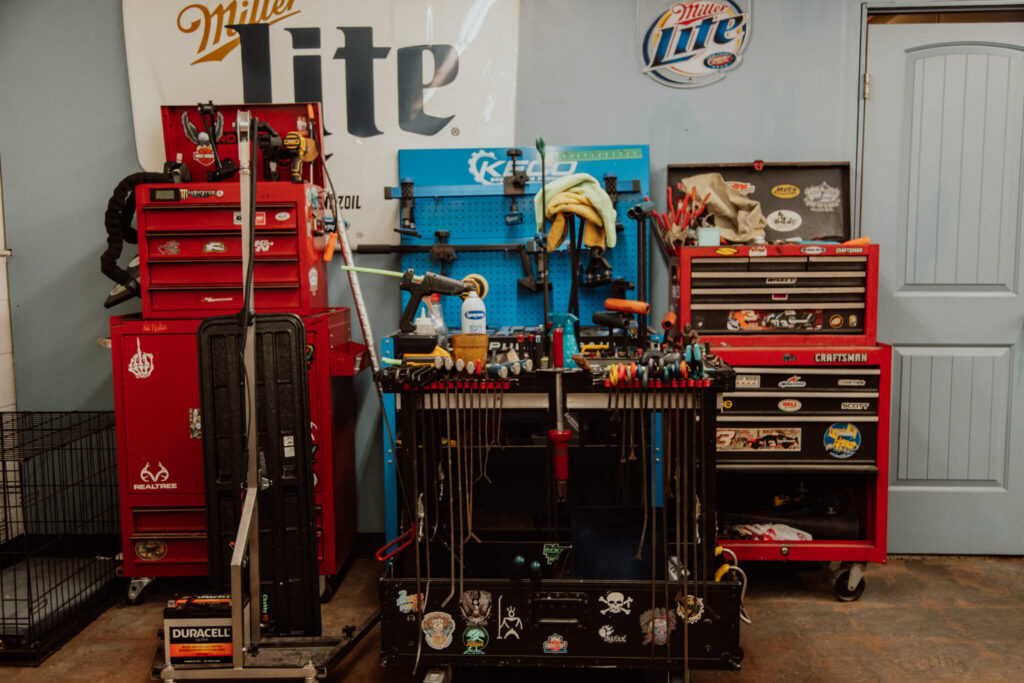
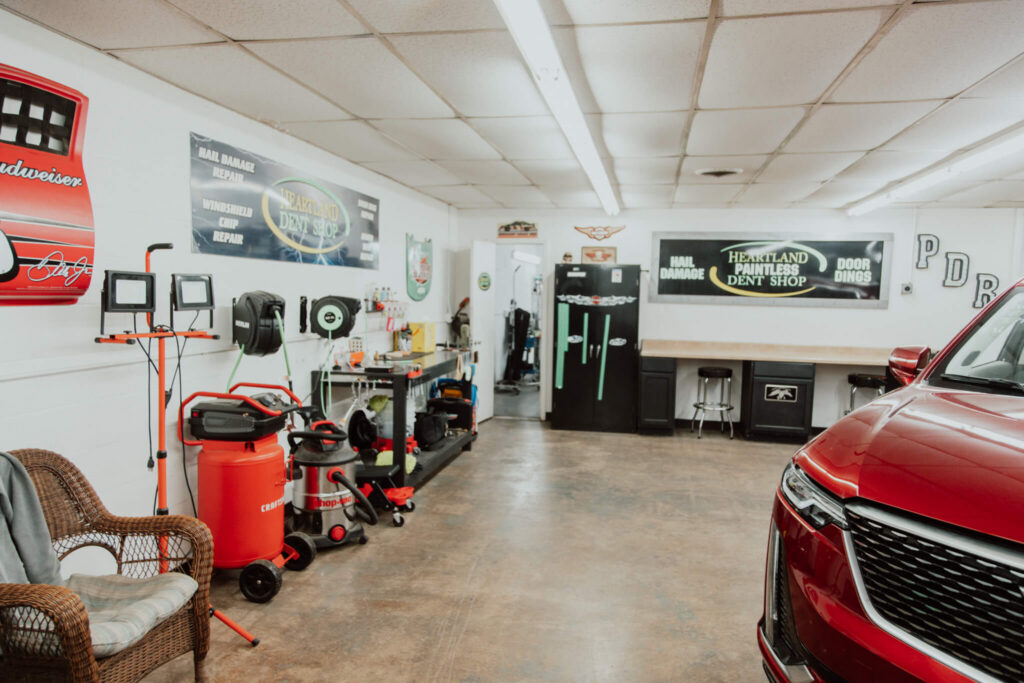
Under bad light, everything looks finished. Dedicated inspection lighting shows the swirls, holograms and missed sections that daylight hides. Our detail bay and our dent bay share this discipline — our dent technicians read damage off reflection boards, which is the same principle applied to metal instead of paint.
Microfiber, and a lot of it
Different weaves for different jobs — plush for buffing, waffle for glass, short-nap for interior surfaces — and clean ones every time. A dropped towel goes in the laundry, not back on the car. Reusing a contaminated towel is one of the fastest ways to install scratches while trying to remove them.
Worth buying yourself?
If you enjoy this: a set of detailing brushes, plenty of good microfiber, and two wash buckets with grit guards will get you most of the visible improvement for very little money. The polisher and extractor are where the cost and the learning curve are, and where most people would rather hand it to someone who does it daily.
If that’s you, our packages and prices are published — Wash & Vac at $85 through Full Detail at $389/$429, plus correction and ceramic. Heartland Dent Shop, 8618 E 46th St, Tulsa, (918) 809-7438
